Following the Clues: An Archivist’s Search for Family Stories
Written By:

Finlandia Foundation
Written by J. Chopp, Archivist, Finnish American Heritage Center Historical Archive
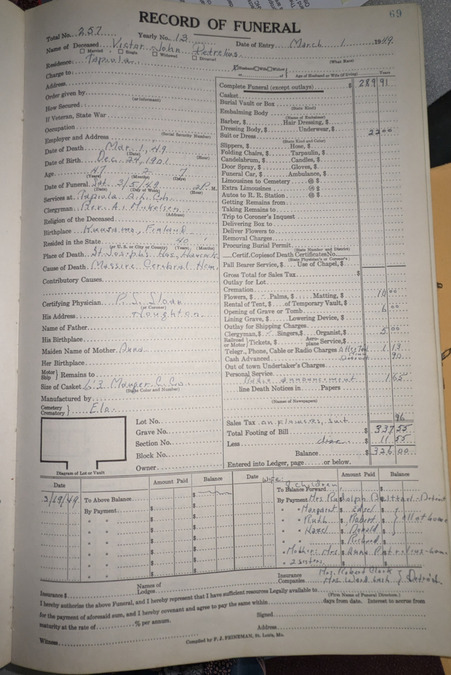
A sample page from the Watia Funeral Home records. This one shows Joanna’s great grandfather, Victor Petrelius.
It’s not unusual for me to have to explain to family, friends, new acquaintances, and FAHC visitors what exactly an archivist does. While the preservation aspects of my job are paramount to the mission of the archive, it’s the chance to play detective that keeps things interesting amidst the more mundane activities of filing and cataloging.
A large portion of research I assist in is genealogical. Researching family history is so much more than logging onto websites like Ancestry.com. While online resources can provide a wealth of information, and email and social media can help you track down and connect with living relatives across the country or around the world, the value of physical archival records and amassed knowledge of archive staff shouldn’t be dismissed in today’s technology driven world.
Many archives, like the FAHC, don’t have their entire collections available online, as digitization is a long process that requires time, expertise, and digital infrastructure. So, it’s often difficult for those seeking family information to know where to start or what’s available when contacting the archive.
For those with ties to our local area, one of my favorite kinds of resources are funeral home records. The FAHC holds such records from two former Copper Country establishments: The Watia and Crawford funeral homes.
Most researchers are surprised at how much information can be gleaned from a single page entry. It’s so much more than a name and date of death. Often, especially in the Watia books for which we have the original hand-written ledgers (the Crawford records are only photocopies,) you can find the person’s home address, cause of death, place of death, place of burial, church affiliation, employer, funeral costs, next of kin, names of parents and children, and other details noted by the undertaker.
We can then take this information and expand the search. For example, if we know where someone died, I can usually point the researcher to the appropriate city or county offices to get a copy of a death certificate. Or I can show them how to use free online databases like www.michiganology.org, where the Archives of Michigan has digitized death certificates from 1897-1952 and Michigan State Census records from 1827-1894. There are a couple ways to search these records online, and depending on the spelling variations or transcription of Finnish surnames, searching successfully can have a bit of a learning curve.
If cause of death was listed as a mining accident, I can direct them toward mine employment records or mine accident reports held by other local archives like the Keweenaw National Historical Park in Calumet, MI, or Michigan Technological University’s Archive in Houghton, MI.
With burial details, a visit could be made to the relevant cemetery to locate gravesites. With death and burial dates, it’s possible to scour the FAHC’s collection of both Finnish and English language newspapers, very few of which are digitized yet. Historic death notices don’t always resemble modern obituaries but can contain details about a person’s life that weren’t recorded in more formal documents.
Knowing where the church service took place can lead to membership records, which often listed further genealogy details such as birth, baptism, confirmation, immigration, and marriage dates, and have often led to the discovery of other relatives in the same congregation, or the full name of an ancestor who always went by a nickname. Sometimes they even indicate an immigrant’s home parish in Finland, enabling the branches of the family tree to stretch across the Atlantic. Each clue provides further insight and opportunities to learn more.
In addition to finding information on a specific person, these funerary records can also shed light on conditions during certain time periods (they cover the early and mid-1900s). I’m always dismayed to see the number of people who died by suicide, starvation, or infection. It serves as a stark reminder that while our immigrant ancestors may have come looking for streets paved with gold, reality was far different.
Funeral home records are not the only genealogically valuable resources in our collections. We are also the repository for membership records for organizations like temperance societies, Finnish-American churches, and the Knights of Kaleva. We have records and yearbooks from the inception of Suomi College, attended by many immigrants and their descendants through the years. Our library collection has numerous family histories from both Finland and North America, and we have both English and Finnish language periodicals, helpful in locating obituaries, anniversary announcements, or community events. Some of these materials have already been indexed by name and the finding aids can be searched on our website.
Genealogy is just one part of what I do in the archive, but it’s my favorite part. Because it’s so personal to the researcher, it also provides some of the strongest emotional response when information is found, an ancestor is located, and someone makes a real tangible connection to the past. I love that I get to be a part of that process.
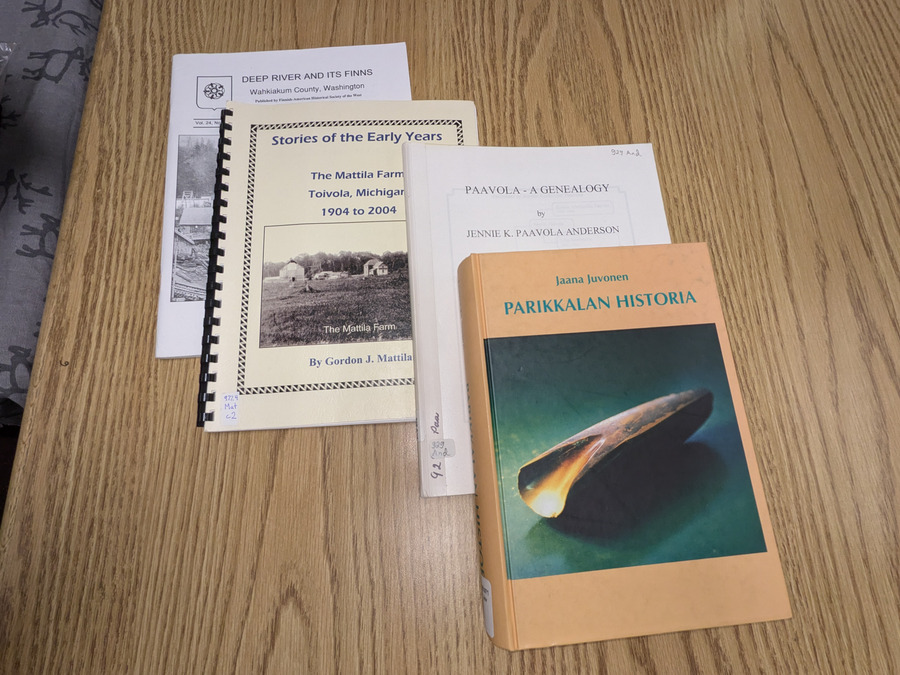
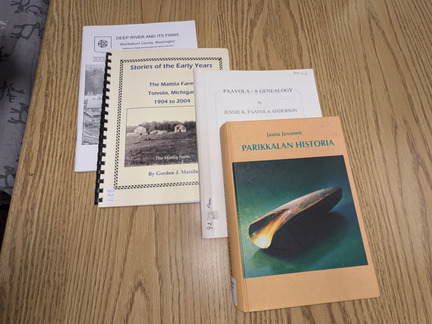
A small sample of several regional/family history books from the archive collection