A FINNO UGRIC WORLD TOUR : Sápmi
Written By:

Minea Herwitz
Gage “Touko” Keränen
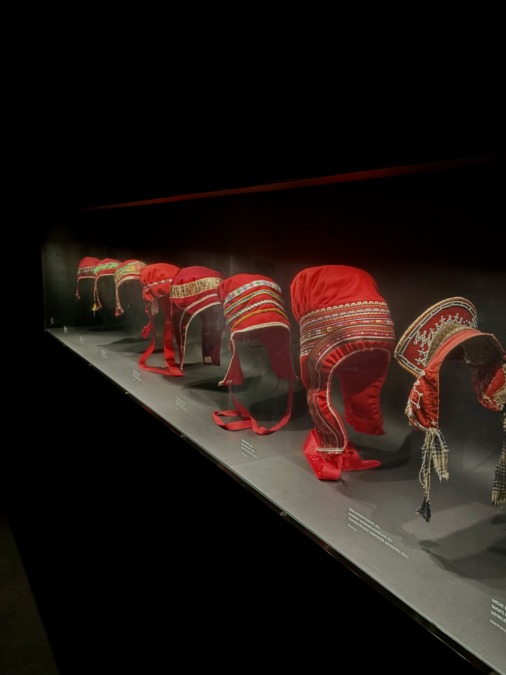
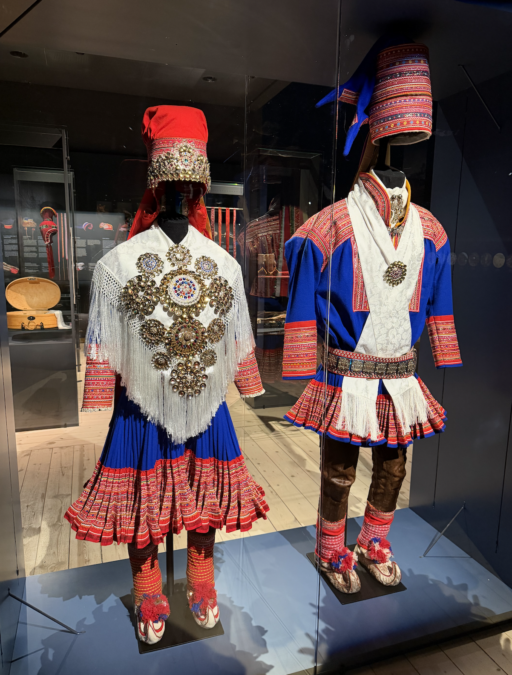
A collection of Sámi headgear featured at the Estonian National Museum in Tartu, Estonia.
It is unknown exactly how many Sámi immigrated to the United States alongside other Nordic immigrants in the late 19th and early 20th centuries.
Upon arrival, Sámi immigrants were classified only according to their nation of origin: Norway, Sweden, Finland, or Russia. Due to the discrimination many Sámi experienced in their homelands, many chose not to disclose their Sámi identity after moving to the US. Thus, a “silent migration” took place, leaving the descendants of immigrants to discover their ancestors’ identities later in life.
Silent too was the language of these Sámi immigrants, as few passed on their language to their children due to isolation and stigmatization. So, what language(s) did Sámi immigrants speak? And how do these languages endure in Finland today?
In Finland, I met professor Ilona Kivinen at the University of Helsinki and doctoral researcher Kristiina Ojala to learn more about the Sámi languages and how new technologies are being used to teach them.
There is no single Sámi language, but 10 different languages within the Sámi homeland, known as Sápmi.
These languages belong to the Finno-Ugric family. Skolt Sámi (300 speakers), Inari Sámi (500 speakers), and Northern Sámi (30,000 speakers) are spoken within Finland.
The Sámi people and their languages were negatively impacted by policies of assimilation which encouraged people to switch from their native language to the national majority language, causing language loss over multiple generations.
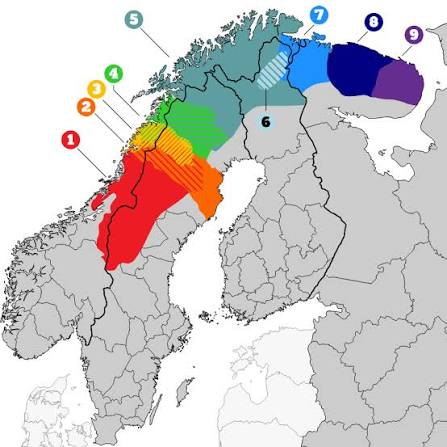
Distribution of the Sami languages (circa 2023): 1. Southern Sámi, 2. Ume Sámi, 3. Pite Sámi, 4. Lule Sámi, 5. Northern Sámi, 6. Inari Sámi, 7. Skolt Sámi, 8. Kildin Sámi, 9. Ter Sámi. Striped areas are multilingual or overlapping. Source: Wikipedia
In recent years, the Sámi languages have attained a protected status in Finland. With this protected status, efforts are being made to raise new speakers and to provide opportunities for adults to learn.
Northern municipalities in the “homeland” area are required to offer public services and education in Sámi, but this is not the case for the rest of Finland.
“This division is a challenge because Sámi language services are needed outside of this “homeland” area,” Ojala explained. “There is a large Sámi community in Helsinki also.”
There is a high demand for teachers and learning materials for all three of Finland’s Sámi languages. Ojala believes that new language technology may be able to help, especially to fill the need for resources outside of Sápmi.

Ojala is working with Aalto University and the University of Lapland to create automatic speech recognition (ASR) technology for Northern Sámi that would help to develop new educational language tools.
The speech recognition system will be capable of transcribing spoken words into text with a speech-to-text tool. As transcribing audio is quite a time-consuming task, this tool will help to save time and to make translation simpler.
Ojala also hopes that this technology can provide some relief to fluent speakers, many of whom are elders.
“Creating speech recognition technology means that older recordings and radio materials can be used to create language content, instead of repeatedly interviewing living speakers, who may feel tired of being “researched,”” Ojala said.
Such a tool could also be used to create a language learning app, similar to Duolingo.
Ojala hopes that, after the program has been successful for Northern Sámi, it will be used for other Sámi languages too.
In the meantime, more opportunities to learn Sámi are being made available for all ages.
“There are classes available in Sámi up to the 9th grade in Pasila. There’s a Sámi kindergarten as well. Right now it’s all available in Northern Sámi but hopefully other languages will be available soon,” Kivinen told me. “There are also language cafes and book clubs in Sámi.”
In her university classes, not all Kivinen’s students are Sámi themselves and she mentioned a few reasons why non-Sámi students are curious to learn Northern Sámi:
“The public school system doesn’t teach them about Sámi languages and history. Some students are just interested in languages, or students want to do more specific research about Sámi people.”
Non-Sámi people have also become integral parts of the language revitalization movement.
For example, Annika Pasanen has become a well-known teacher and speaker of Inari Sámi, while not being Sámi herself. There are also Finnish families living in Sápmi who choose to send their children to Sámi language schools in support of local language efforts.
In the US too, descendants of Sámi immigrants have organized language classes for Northern Sámi at the American Swedish Institute and formed organizations, such as Sámi Circle North America.
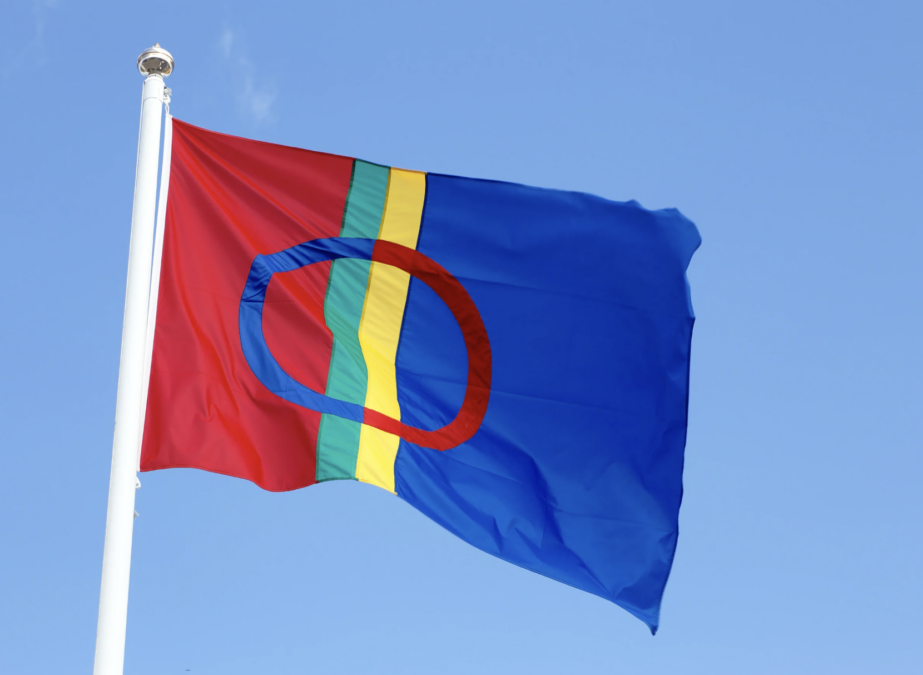
Today, the Sámi flag (in red, green, yellow, and blue) flies proudly next to the Finnish flag at many events and Sámi-Americans play a vital role in the Finnish-American community.
This year’s Finno-Ugric festival in Hancock, Michigan celebrates the diverse roots of Finnish-Americans and you can read more about the festival year at FinlandiaFoundation.org/Hancock2026.