A FINNO UGRIC WORLD TOUR: Mari El
Written By:

Gage "Touko" Keränen
By Gage “Touko” Keränen
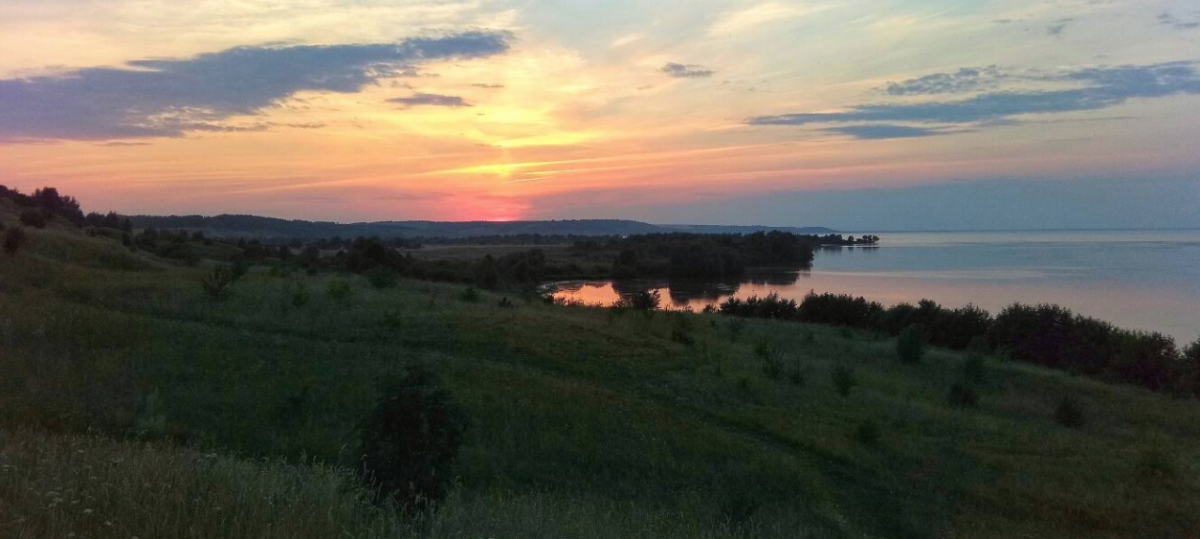
A distinct geographical feature of Michigan’s shoreline along Lake Superior is the colorful sandstone cliffs, where many layers of red, yellow, and brown rock meet ferocious waves. For a Finnish-American of the Copper Country, these landmarks are a welcoming sight on long journeys home, but 5,000 miles away, there are distant cousins of ours who hold similar nostalgic feelings about their own rocky shores.
In the Mari El Republic, they call one such cliff ”Shanavÿl Kü” or “rainbow stone,” which lies along the Yunga river and whose layers of clay are arranged in an arching form. This site is sacred to the Mari people, a Finno-Ugric people who call Mari El home and whose folk stories are populated with rainbows of both sky and stone.
Mari El is situated within Russia and there are nearly 424,000 Maris living there, with the largest diasporas being in Kazakhstan and Ukraine. It is estimated that 225 Maris live in Estonia, two of whom I had the pleasure of interviewing in the past year.
In Tallinn, Estonia’s capital, I visited the exhibition of painter Zhanna Toht, who moved to Estonia when she was 22. Her recent exhibition in Tallinn is distinguished by the unique blending of two mediums: watercolor paint and embroidery.
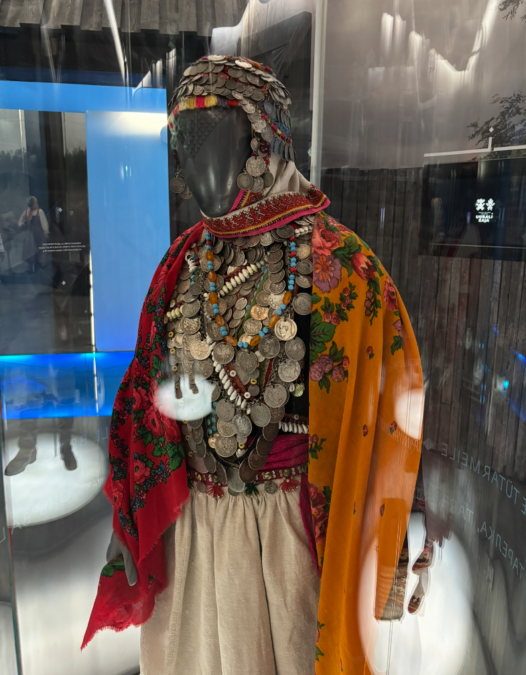
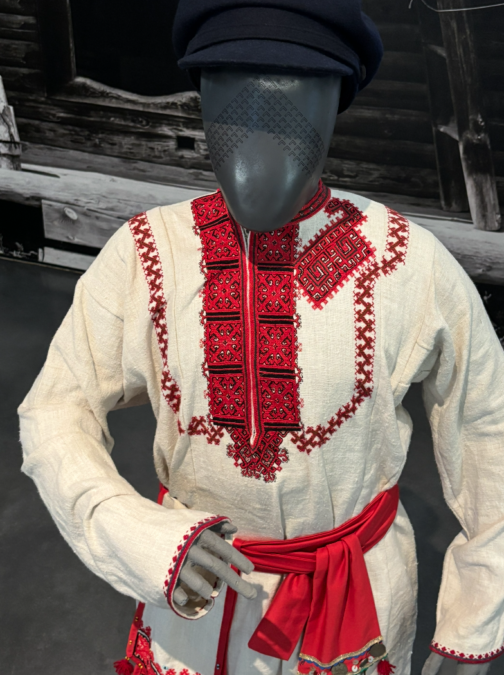
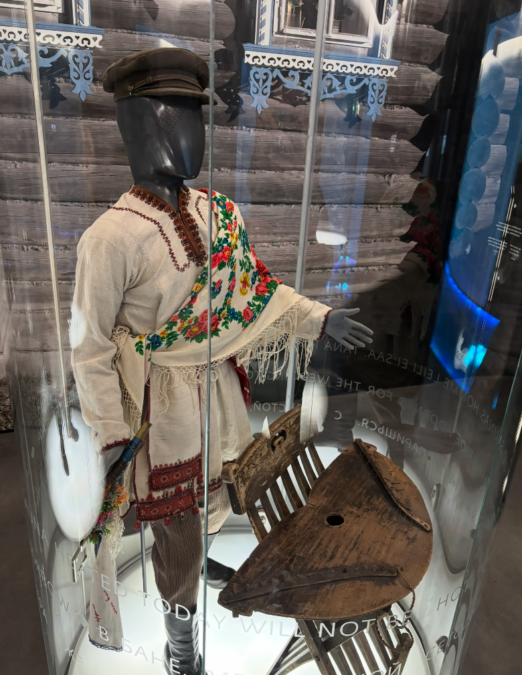
Mari embroidery is particularly known for its symbols, essential parts of folk clothing which carry meaning for the wearer. This system of symbols is a language of its own, and Toht’s exhibition incorporates them into her paintings to tell a story, carefully embroidering over her watercolor paintings.
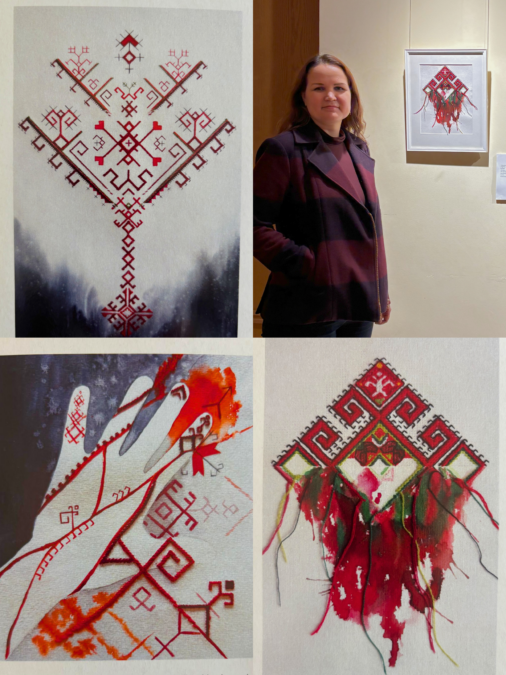
The symbols in her works represent creation, the sun, family, vitality, and protection, which appear in paintings depicting her childhood home, waterfowl, men, women, wildlife, and the spiritual beliefs of the Mari people.
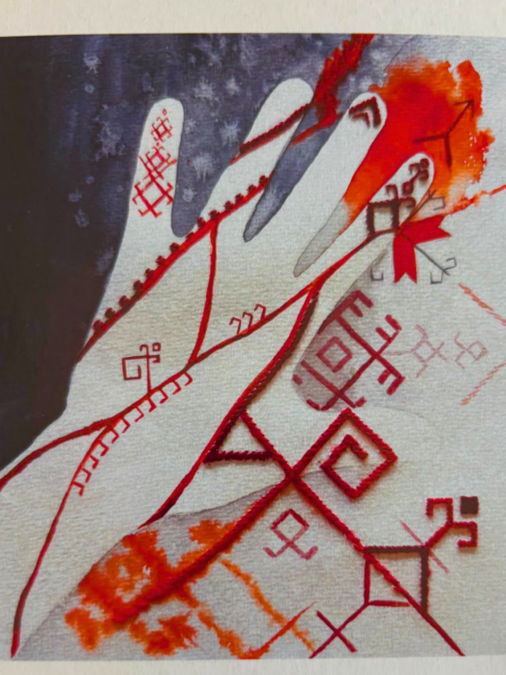
In her exhibition description, Toht explains why she chose embroidery as her medium:
It is believed that red embroidery on clothes symbolizes blood vessels that form various patterns. The red color of embroidery is associated with lineage, love, and destiny. Embroidery has always been a way to write your destiny on clothes, reflect the beauty of the surrounding nature, and protect yourself from the evil eye.
Today, the Mari language is endangered and few youth are raised with Mari as their first language. Toht believes that she may be part of the last generation to speak it as her mother tongue. She warns that this very well could be the fate of other smaller languages, such as Estonian.
“I often tell Estonians to think about how their situation may be similar someday. As more young people use English, the Estonian language may also become endangered.”
Toht hopes that younger generations from all backgrounds will see their heritage as a medium with which to paint their futures.
“In today’s society, where customs are fading and everyone has the opportunity to create their own worldview, a connection to roots helps to make sense of the environment, role, and identity. I hope that the experiences and wisdom of our ancestors also fit into this picture.”
To learn more about the current circumstances surrounding the Mari language and culture, I also spoke with Vasily Nikolaev, the creator of the website MariUver, meaning “Mari news.”
MariUver was founded to collect and distribute information about the Mari people, Mari El, and other non-Russian peoples of Russia. It often serves as a kind of digital newspaper for Mari people worldwide.
One of the main challenges facing the Mari within their homeland today is linguistic and cultural assimilation. The main force responsible for this is Russification, a policy which targets the indigenous peoples within Russia and discourages the teaching of their languages.
“Assimilation has a disastrous effect, and statistics confirm this. In the Kirov region, over the last twenty years, the number of Mari has decreased almost three times,” Nikolaev explained. “Almost everywhere, even in villages, Mari speak only Russian with their children.”
Through MariUver and supporting cultural programs, Nikolaev hopes to create a positive image of Mari identity which emboldens families to pass on their heritage at home.
For those who seek to learn or to keep their language alive, he has specific advice:
You should never be ashamed to speak your native language. If you don’t know how or speak poorly, start learning and practicing. Constant communication helps to improve the language and make it alive… Study your traditions, culture, and history more deeply. And most importantly, you must preserve the Mari language in the family; it is essential to pass it on to your children.
Given that the majority of the world’s Finno-Ugric languages are facing a similar decline in speakers, Nikolaev believes that collaboration between cultures may well be a necessary ingredient for collective survival.
“Finno-Ugrians have always been drawn to each other and shared experiences,” he told me. “We learn from each other how to survive and develop in the modern world. Such cooperation gives strength for the preservation of national culture.”
In the end, it may be the great diversity among us –”the shining Finno-Ugric rainbow” as Mari poet Pal Genaj calls it– that weaves a canvas on which future generations will write their own destinies.
“We’ve scattered across the wide world, and still
managed to lose ourselves in our own home.
Step out of Shanavÿl Kü, if you dare — our
freedom’s been waiting there, tapping its foot.”
Pal Genaj
Interested to learn more about the Mari language and culture? Read more at MariUver: mariuver.eu.
We’re just over halfway into this year’s Finno-Ugric festival year in Hancock, Michigan! If you’d like to learn more or plan a trip, visit FinlandiaFoundation.org/Hancock2026. See you there! Nähdään pian!