What’s the Oldest Item in Our Collection? You’ll Never Guess
Written By:

Finlandia Foundation
By J. Chopp, Archivist, Finnish American Heritage Center Historical Archive
Visitors often ask what the oldest item is in the archive collections. You might think it’s our two copies of the Bible printed in Finnish from 1642. They are definitely the oldest books in our collection, at 384 years old, and have their own interesting story.
The actual oldest items are documents, though not in any media or language you would expect to find in an archive started by Finnish Lutheran immigrants in the far northern reaches of Michigan’s Upper Peninsula. I was shocked when an intern brought them to my attention a decade ago while she was sorting and identifying uncatalogued artifacts. No one ever expects the answer to the question about oldest item to be, “Two Babylonian clay tablets.”
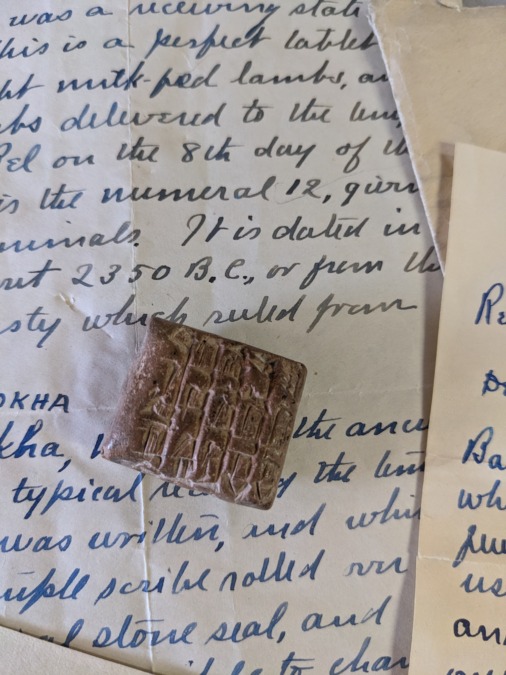
She handed me a small box that contained small objects collected by several of the early presidents of Suomi College. The box included two hardened clay tablets, each about two inches square, and covered in an angular cuneiform script. Also in the box were two letters that thankfully shed some light on what we were looking at.
The letters were correspondence between a man named Edgar J. Banks and Suomi College president John Wargelin discussing the origins and sale of these little gray lumps. According to the letters, they were bought in 1921 by Wargelin, for a price of eight dollars. After some online research, we learned that Banks was an American diplomat in the Middle East in the early decades of the 1900s. Among his other pursuits, he was what some called an “entrepreneurial roving archaeologist.” Today he might be called a grave robber, or at the very least an exploitative opportunist.
Using his position and academic connections to gather funding, he oversaw digs across the Ottoman Empire. Lax enforcement of regulations on the purchase and export of such small antiquities allowed him to take many such clay tablets back to the United States, where he sold them to libraries, universities, museums, and seminaries. No one seems to know exactly how many he sold before his death in 1945 but estimates range as high as 150,000. Interestingly, the Wikipedia article about Banks holds him up as one possible inspiration for the fictional character of Indiana Jones. It seems he would have agreed with Indy’s conviction that artifacts, “belong in a museum.”
We also don’t know Wargelin’s motivation to purchase them. Suomi College had a seminary at the time. It is possible they were used as visual aids for a history or theology course.
Banks’ letters helpfully translated the text on the tablets. One is supposedly a receipt for the sale of lambs, while the other is a record of a typical temple offering, marked with the seal of a temple scribe from Jokha, which is in present-day Iraq. The tablets date back to about 2300 B.C. While it raises legitimate questions about the ethics of removing so many historical items from their place of origin for profit, it is also quite humbling to hold documents created thousands of years ago and half a world away from the Copper Country.