More Than a Sign: A Political Story Preserved in the Archive
Written By:

Finlandia Foundation
FROM THE ARCHIVE
By J. Chopp, Archivist at Finnish American Heritage Center Historical Archive
People often imagine an archive with long rows of shelves stacked high with books and boxes of papers. That’s the metaphorical bread and butter of a traditional archive, and the FAHC is no exception. We are also the home of a significant artifact collection, preserved with the same intent as all of the letters, photos, and newspapers – to tell the stories of individuals and the Finnish American community.
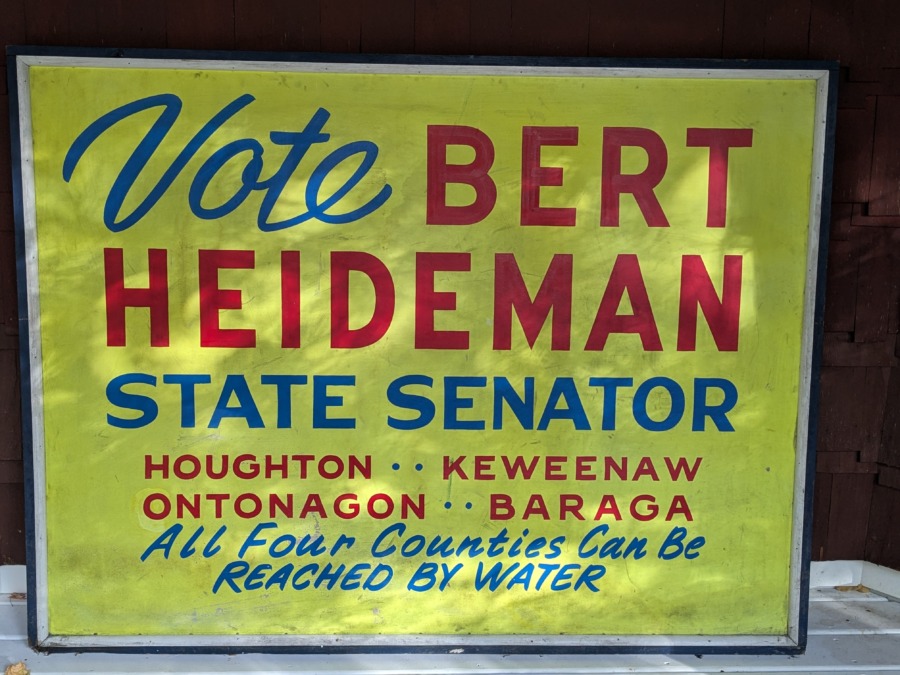
Sometimes the FAHC Archive receives a donation that falls somewhere between a historical document and an artifact. An interesting example of this is a campaign sign. It’s a physical object, but it also documents a political identity, a specific election cycle, regional or cultural values, and evolving design trends.
Born in Calumet, MI to the well-known Rev. Arthur and Lempi Heideman, Bert Heideman had deep roots in the Copper Country. He and his wife, Kathrine, were both very involved in education: He as a history professor at Michigan Technological University, and she as the Copper Country Intermediate Superintendent of Schools for nearly two decades.
They were both also very civically minded people. They were ardent supporters of Suomi College and FinnFest. He ran (unsuccessfully) for a seat in both the Michigan Senate and House several times in the 1950s and 1960s. She was a long-serving member of Hancock’s City Council, pivotal in establishing the sister city relations between Porvoo, Finland and Hancock, and was a driving force on many major municipal construction projects and a local ordinance to prevent toxic or nuclear waste from being disposed of in the city.
This 2-sided, hand-painted sign had Bert Heideman’s name on it, but Katherine was present behind the scenes. The FAHC Archive also has a recording of a campaign song written and performed by Katherine in support of her husband’s political pursuit in 1962, as well as campaign memorabilia from that year.
What the sign doesn’t provide is a clear explanation of its content. Why was it important to note that the counties represented could all be reached by water? Was this part of a larger slogan? Was there a particular issue on the minds of constituents at the time that this sign spoke to? If anyone has any recollections or insights into this, please reach out to the FAHC Archive. The archivist can be reached by email at: joanna.chopp@finlandiafoundation.org